Why Good Leaders Sometimes Get the Wrong Response
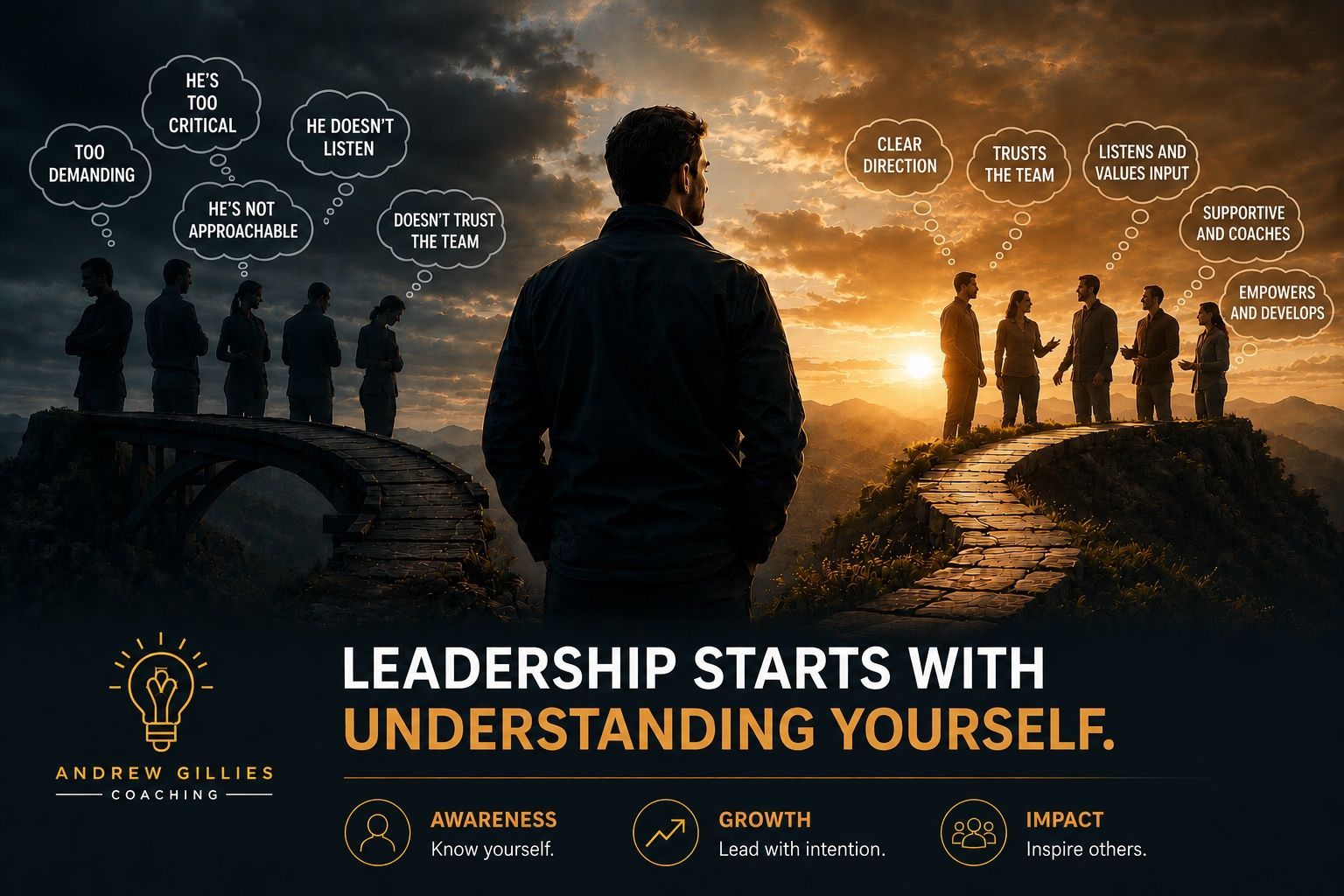
Leadership Starts With Understanding Yourself
Most leaders don't set out to create confusion, frustration or disengagement within their team.
In fact, many are highly committed people who genuinely care about achieving results and supporting those around them.
Yet despite their best intentions, they sometimes find themselves asking:
- Why am I getting resistance when I'm trying to help?
- Why does the team seem hesitant?
- Why aren't people speaking up?
- Why aren't people taking ownership?
The answer often has less to do with what the leader is trying to achieve and more to do with how their behaviour is being experienced by others.
This is one of the most overlooked aspects of leadership development.
Many leaders focus heavily on strategy, systems and outcomes. While these are important, leadership effectiveness is ultimately influenced by something far more personal: self-awareness.
Intent and Impact Are Not Always the Same
One of the most important lessons leaders can learn is that intent and impact are rarely identical.
A leader may believe they are being decisive.
Others may experience them as impatient.
A leader may think they are providing direction.
Others may experience them as controlling.
A leader may believe they are driving accountability.
Others may experience them as being critical or over analysing.
This gap between intent and impact often grows wider when leaders are under pressure.
Deadlines tighten.
Workloads increase.
Stress rises.
Communication becomes shorter, more task-focused and policy driven.
Without realising it, leaders can create an environment where people become cautious, less engaged and less willing to contribute openly.
Leadership Under Pressure Reveals Patterns
Pressure does not create leadership behaviour.
It reveals it.
When leaders become aware of their behavioural patterns under pressure, they gain the ability to make different choices.
That awareness creates choice.
Choice creates growth.
Growth creates better leadership outcomes.
The most effective leaders are not those who never feel pressure.
They are the leaders who understand how pressure influences their behaviour and who deliberately adjust their approach to maintain trust, communication and connection.
Self-Aware Leadership Creates Better Teams
Strong team dynamics rarely happen by accident.
They are built through trust, communication and psychological safety.
When leaders understand how they are experienced by others, teams become more willing to:
- Share ideas
- Challenge assumptions
- Engage in healthy debate
- Raise concerns
- Take ownership
This creates stronger workplace relationships and more cohesive teams.
It also improves team performance because people spend less time managing uncertainty and more time contributing meaningfully.
Leadership Is a Continuous Journey
Leadership is not about perfection.
It is about awareness.
The leaders who continue to grow are those who remain curious about themselves, their behaviour and the impact they have on others.
That is why the Discover | Evolve | Succeed Leadership Program focuses on developing practical leadership skills through self-awareness, behavioural awareness and leadership application.
Because leadership doesn't begin with managing others.
It begins with understanding yourself.
Ready to Develop Your Leadership?
If you want to become a more self-aware leader, improve your leadership communication and build stronger team dynamics, the Discover | Evolve | Succeed Leadership Program provides practical tools that can be applied immediately in the workplace.
Discover yourself.
Evolve your leadership.
Succeed with your people.


